

Diesel Prices Dip, but Is Another Rise Already Coming?
Author
Stephen Corser
Date Published
Australian businesses received a small amount of relief at the bowser last week, with the national average diesel price falling by 2.6 cents to 245.4 cents per litre in the week ending 16 August 2026.
Unfortunately, the movement taking place further up the supply chain tells a very different story. While Australian diesel prices were falling, the Singapore Gasoil benchmark surged by around 10 cents per litre.
That does not guarantee an immediate 10-cent increase at Australian bowsers. However, it is a strong indication that the recent diesel price relief may be short-lived.
Why Did Australian Diesel Prices Fall?
According to the Australian Institute of Petroleum, the national average diesel price fell to 245.4 cents per litre during the week ending 16 August. Metropolitan prices dropped by 4.1 cents per litre, while regional prices fell by a more modest 1.4 cents.
For transport operators, construction companies, mining sites, agricultural businesses and other heavy diesel users, any reduction in fuel costs is welcome. Even a movement of a few cents can make a noticeable difference when a business is purchasing thousands of litres.
However, the price displayed at the bowser today does not necessarily reflect what is currently happening in the international fuel market.
Australian diesel prices are closely connected to Singapore Gasoil 10 ppm, which is the primary regional benchmark used for diesel. Changes in this benchmark generally take time to flow through the supply chain and reach Australian wholesale and retail prices.
This means the fall recorded during the week ending 16 August was influenced by earlier market conditions. It does not fully reflect the sharp increase that was taking place offshore at the same time.
The 10-Cent Wave Building Offshore
During the same reporting period, the Australian-dollar price of Singapore Gasoil increased by approximately 10 cents per litre.
International price movements are not passed directly to Australian businesses overnight. Fuel must be purchased, shipped, stored and distributed before changes appear in local terminal gate and retail prices.
There is commonly a delay of one or two weeks between a significant movement in Singapore prices and its effect on Australian diesel prices. Exchange rates, shipping costs, taxes, local competition and existing supply contracts can also influence the final result.
The important point is that Australian diesel users may currently be seeing the end of an earlier price reduction while a new upward movement is already working its way through the system.
Why Diesel Prices Matter to Australian Businesses
Diesel is not simply another operating expense for many Australian businesses. It keeps trucks moving, machinery working, generators running and remote sites operating.
A price increase can affect:
- Transport and logistics costs
- Construction and civil project margins
- Agricultural production and freight
- Mining and quarrying operations
- Remote power generation
- Plant and machinery operating costs
The impact becomes more significant when fuel represents a substantial part of a business’s weekly expenditure. A company using 20,000 litres of diesel would pay an additional $2,000 for the same volume following a 10-cent-per-litre increase.
Businesses cannot control international oil markets or the Australian dollar. They can, however, improve the way they purchase, store, dispense and monitor their own fuel.
Greater Fuel Storage Can Provide More Purchasing Control
Businesses that rely entirely on frequent small deliveries or retail fuel purchases have limited control over when they buy diesel. They often have to accept the market price available when their vehicles, equipment or onsite storage requires fuel.
Installing appropriately sized onsite diesel storage can provide greater purchasing flexibility. Rather than waiting until fuel is urgently needed, a business can plan deliveries around its expected consumption, available storage capacity and current market conditions.
This does not mean attempting to predict every price movement or stockpiling fuel unnecessarily. Diesel prices remain volatile and can move in either direction.
The practical benefit is having more choice. If a business has safe, compliant and secure storage available, it may be better positioned to purchase fuel before a known increase reaches local suppliers. It can also consolidate deliveries and reduce its reliance on retail bowsers.
Self-Bunded Diesel Tanks for Australian Operations
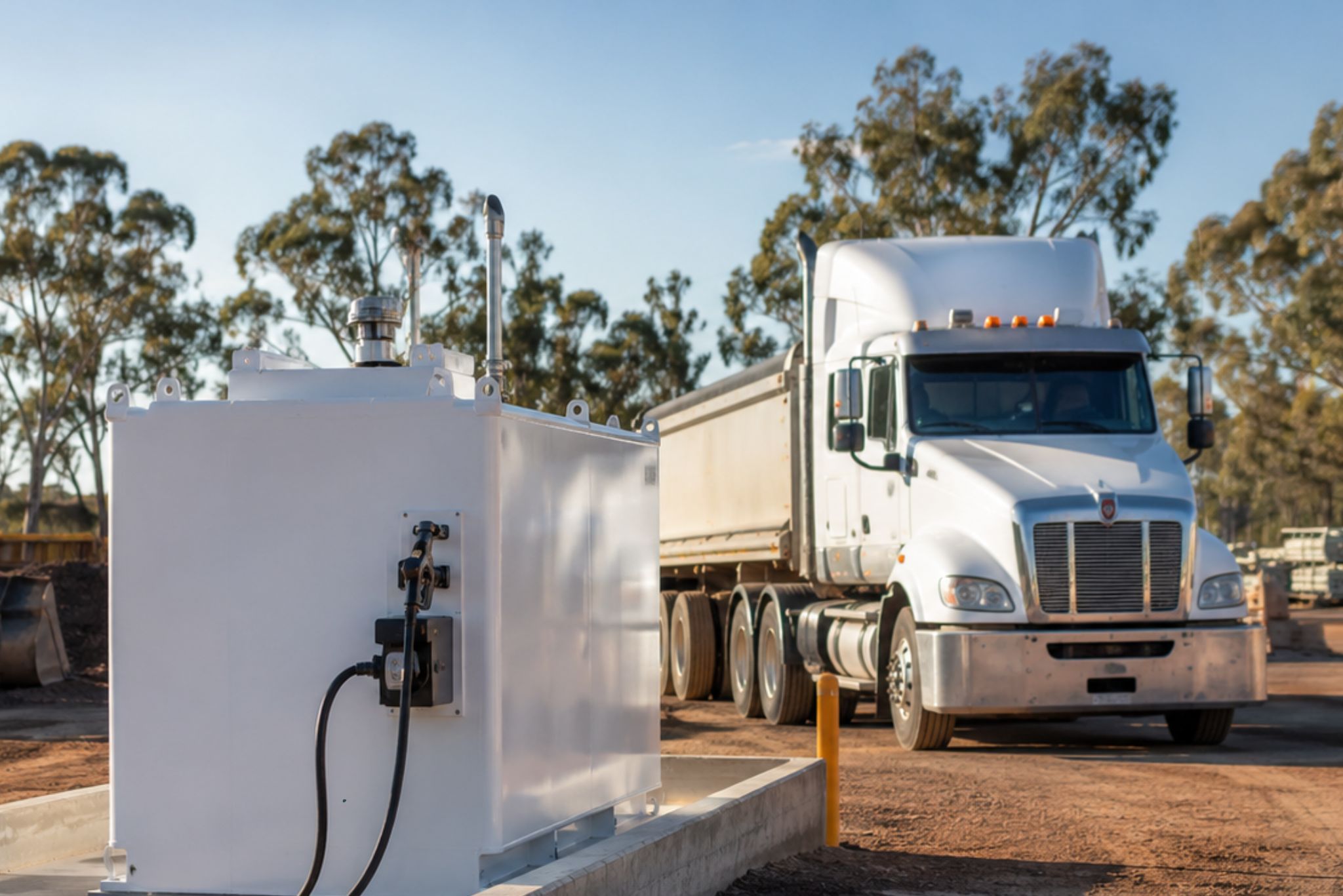
For businesses looking to increase their onsite diesel storage, a self-bunded fuel tank can provide a secure and practical solution.
Self-bunded tanks use a double-walled construction. The outer wall acts as integrated secondary containment, helping to protect the surrounding site if the primary tank leaks.
Tanks On Site supplies self-bunded diesel tanks in capacities ranging from smaller 1,000-litre units through to large-scale tanks exceeding 75,000 litres. This makes them suitable for operations including transport depots, construction sites, farms, mines and industrial facilities.
Depending on the application, a self-bunded tank can include:
- Lockable filling and dispensing points
- Commercial diesel pumps and dispensers
- Tank gauging and level monitoring
- Fuel management technology
- Alarms and additional safety equipment
- Customised access and dispensing configurations
The correct tank capacity should be based on genuine operational requirements. Current diesel consumption, delivery frequency, site conditions, available space and future growth should all be considered before selecting a system.
Storage Alone Is Only Part of the Solution
A larger diesel tank creates additional purchasing flexibility, but businesses still need visibility over how that fuel is being used. Without accurate monitoring, it can be difficult to identify unexplained losses, unauthorised dispensing, inefficient machinery or differences between fuel delivered and fuel consumed.
Tanks On Site can integrate Tecalemit fuel management technology with its storage and dispensing systems. Depending on the system selected, businesses can monitor tank levels, record fuel transactions and create clearer accountability across vehicles, equipment and users.
This turns an onsite tank into a more complete fuel management system. The business gains both additional storage capacity and better information for making purchasing and operational decisions.
During periods of high diesel prices, even relatively small improvements in fuel accountability can produce meaningful savings.
Reducing Dependence on the Retail Bowser
Onsite diesel storage can also reduce the time vehicles and operators spend travelling to service stations. For a transport fleet or construction business, the true cost of retail refuelling is not limited to the price displayed on the sign. It can include travel time, driver wages, vehicle downtime and lost productivity.
A properly designed onsite system allows vehicles and machinery to be refuelled at the depot or worksite. This can improve operational efficiency while giving the business a clearer understanding of how much fuel is being used.
For projects that change location or require temporary infrastructure, Tanks On Site also supplies portable fuel stations. These self-contained systems combine storage and dispensing equipment in a transportable configuration, with options ranging from approximately 5,000 litres to more than 20,000 litres.
Is Now the Right Time to Review Your Fuel Storage?
One weekly price movement should not be the sole reason for investing in a new fuel storage system. The stronger argument is the continued volatility of diesel prices and the effect that volatility can have on Australian businesses.
A review may be worthwhile if your business:
- Purchases a high volume of diesel
- Relies heavily on retail service stations
- Frequently requires urgent fuel deliveries
- Has insufficient storage for normal operations
- Cannot accurately track onsite fuel use
- Is expanding its fleet, machinery or project workload
- Needs a safer and more compliant storage arrangement
The recent fall to 245.4 cents per litre may offer temporary relief, but the rise in Singapore Gasoil shows how quickly the market can change. Businesses with suitable storage and reliable fuel management systems have more options when those changes occur.
Build a Fuel Storage System Around Your Operation
At Tanks On Site, we design and supply complete fuel storage and dispensing solutions for businesses across Australia.
Our team can assess your fuel consumption, site requirements and operational priorities before recommending the right tank capacity and equipment. This may include a self-bunded diesel tank, pumping and dispensing equipment, tank gauging and an integrated Tecalemit fuel management system.
The objective is not simply to store more diesel. It is to give your business a safer, more efficient and more controlled way to purchase and manage one of its most important operating costs.
To discuss an onsite diesel storage solution, contact Tanks On Site on 1300 210 480 or request a tailored recommendation.